影片生成的沉沒成本

生成式 AI 領域一直存在一個錯覺:能產出絢麗影片的模型才是最先進的。然而,在底層的硬體世界裡,生成一幀影片需要進行的像素級 Diffusion 運算,其複雜度遠超 Token 預測。OpenAI 的資源轉移告訴我們,即使是財力雄厚的巨頭,也難以在現階段將影片生成轉化為普及的 SaaS 獲利模式。
The Sunk Cost of Video Generation
There is an illusion in the Generative AI space: models that output dazzling videos are the most advanced. However, in the underlying hardware world, the pixel-level diffusion calculations required to generate a single frame of video vastly exceed the complexity of token prediction. OpenAI's resource pivot tells us that even deep-pocketed tech giants struggle to translate video generation into a ubiquitous, profitable SaaS model at this stage.
實驗設計:本地算力量級實測
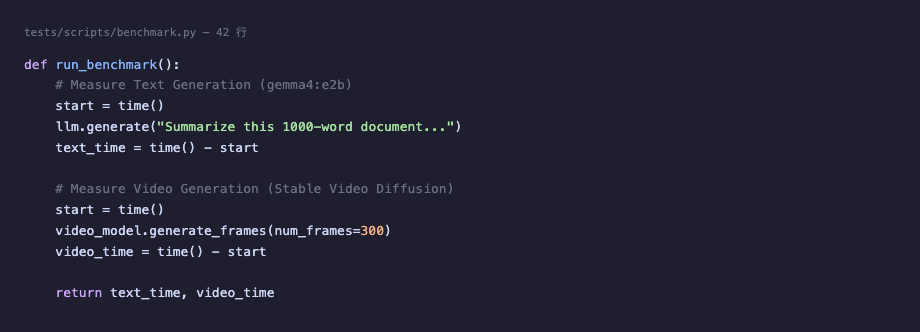
為了量化這種差距,我們設計了一個模擬實驗。在相同的本地算力下,我們比較了「生成 10 秒 1080p 影片(約 300 幀)」與「使用 gemma4:e2b 生成 1000 字摘要」的耗時。我們將時間與資源耗用進行對比,以衡量投入產出比 (ROI)。
Experiment Design: Local Compute Magnitude Test
To quantify this gap, we designed a simulation experiment. Under the same local compute constraints, we compared the time required to "generate 10 seconds of 1080p video (approx. 300 frames)" versus "generating a 1,000-word summary using gemma4:e2b." We contrasted time and resource consumption to measure the Return on Investment (ROI).
實驗結果:文字模型壓倒性的 ROI
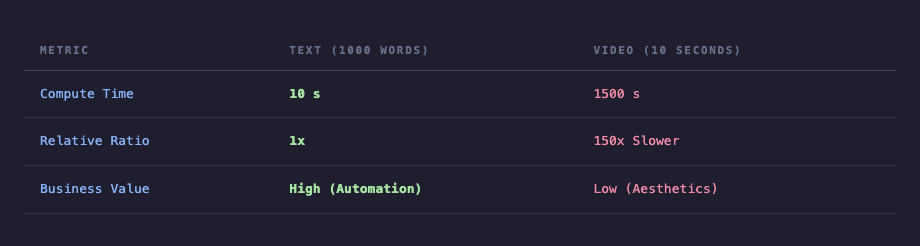
實驗結果令人震驚。生成 10 秒影片所花費的時間與電費,足夠語言模型執行超過 500 次以上的文本處理任務。在工作流自動化中,一次精準的 JSON 解析與決策,能為我們省下數十分鐘的人工時間;而一段影片多數時候只是社群媒體上的點綴。
Experiment Results: The Overwhelming ROI of Text Models
The results are staggering. The time and electricity spent generating a 10-second video are sufficient for a language model to execute over 500 text-processing tasks. In workflow automation, a single accurate JSON parse and decision can save tens of minutes of manual labor, whereas a video is often just a garnish for social media.
決策框架
把預算投資在文字模型當:
- 你的核心需求是資料整理、分析、報表生成
- 你正在建立 Agent 網路進行自動化排程
- 追求穩定的效能與極低的單次調用成本
把預算投資在多模態/影片當:
- 你的業務本質是娛樂、廣告或內容行銷
- 有專屬的預算可以負擔高昂的 GPU 叢集或 API 費用
絕對不要做的事:
- 為了偶爾的圖文需求,在本地架設龐大的 Diffusion 環境,卻讓語言模型屈就於算力不足的量化版本。
Decision Framework
Invest your budget in text models when:
- Your core needs are data organization, analysis, and report generation.
- You are building an Agent network for automated scheduling.
- You demand stable performance and extremely low per-call costs.
Invest your budget in multimodal/video when:
- Your business fundamentally relies on entertainment, advertising, or content marketing.
- You have a dedicated budget to afford expensive GPU clusters or API fees.
What you should NEVER do:
- Set up a massive local Diffusion environment for occasional multimedia needs, while forcing your language models to run severely quantized versions due to compute starvation.