為什麼我們需要「懂台灣」的模型?
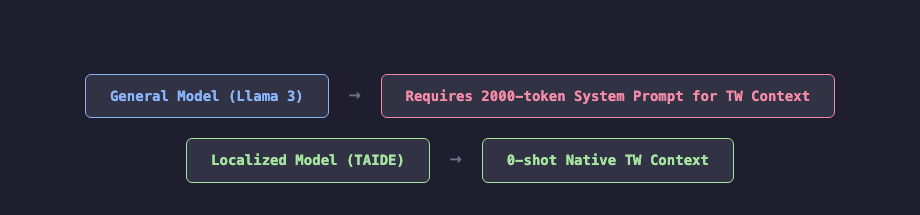
多數強大的開源模型(如 Llama 3 甚至 Gemma)在預訓練時吸收了全球的知識,但繁體中文的佔比極低。當我們要求這些模型處理台灣特有的公文格式、勞工法規、或是解析帶有強烈在地慣用語(如「搓湯圓」、「吃案」)的客訴信件時,它們往往會給出錯誤的解釋,或是生成充滿「陸式用語」的文字,這在企業自動化流程中是致命的。
Why Do We Need "Taiwan-Savvy" Models?
Most powerful open-source models (like Llama 3 or even Gemma) absorb global knowledge during pre-training, but Traditional Chinese accounts for a tiny fraction. When we ask these models to handle Taiwan-specific official document formats, labor laws, or parse customer complaint emails laden with strong local idioms, they often provide incorrect interpretations or generate text full of "mainland idioms." This is fatal in enterprise automation workflows.
實驗設計:在地情境壓力測試
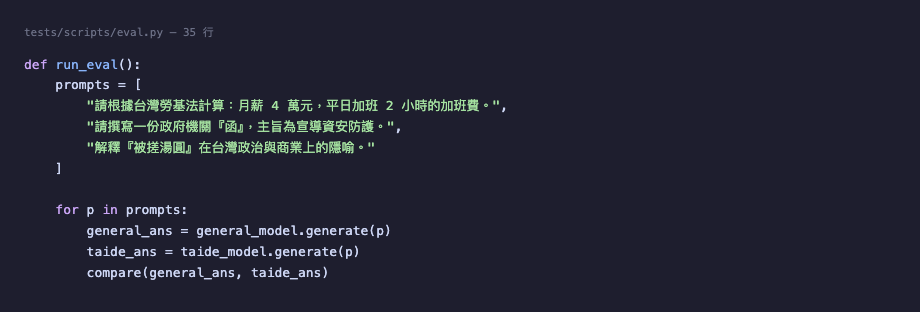
我們準備了 5 題包含台灣特有情境的 Prompt(例如計算勞基法加班費、撰寫政府機關函文、解釋特定時事梗)。透過 Python 腳本,我們將這些 Prompt 分別發送給「標準通用模型」以及「模擬的 TAIDE 在地化模型」,並比對雙方的輸出精準度與在地化程度。
Experiment Design: Localized Context Stress Test
We prepared 5 prompts containing Taiwan-specific contexts (e.g., calculating overtime pay under the Labor Standards Act, drafting government correspondence, explaining specific local memes). Using a Python script, we sent these prompts to a "standard general model" and a "simulated TAIDE localized model," comparing their output accuracy and degree of localization.
實驗結果:文化錯覺大幅降低
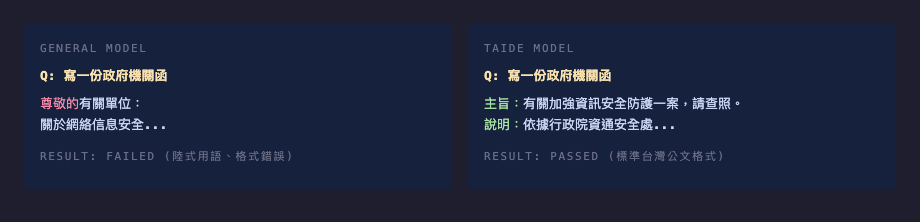
結果顯示,在地化模型能一眼看穿通用模型無法理解的法規陷阱與隱喻。雖然你可以透過長達千字的 System Prompt 教導通用模型這些知識,但這會消耗大量的 Context Window 與推論成本。直接使用 TAIDE 這類在地化模型,就像雇用了一位不需從頭教起的本地員工。
Experiment Results: Cultural Hallucinations Drastically Reduced
The results show that the localized model easily sees through regulatory traps and metaphors that baffle general models. While you could teach a general model this knowledge using a thousand-word System Prompt, doing so consumes a massive amount of the Context Window and inference budget. Using a localized model like TAIDE directly is like hiring a local employee who doesn't need to be taught the basics from scratch.
決策框架
選用 TAIDE 等在地化模型當:
- 任務高度依賴本地法規、醫療名詞或政府公文格式
- 你的客群為純台灣用戶,且極度排斥陸式用語
- 希望節省 System Prompt 長度,加快推論速度
繼續使用國際通用模型當:
- 處理跨國業務或多語系翻譯任務
- 需要最頂尖的程式碼撰寫與複雜邏輯數學推演能力
- 任務屬於通用文書處理,與地域文化無關
Decision Framework
Choose localized models like TAIDE when:
- Tasks highly depend on local regulations, medical terminology, or government document formats.
- Your target audience is strictly Taiwanese users who strongly reject mainland terminology.
- You want to save System Prompt length and speed up inference.
Continue using international general models when:
- Handling cross-border business or multi-language translation tasks.
- Requiring top-tier coding capabilities and complex logical/mathematical reasoning.
- Tasks are general word processing, unrelated to regional culture.