雲端巨獸 vs 本地微縮模型

雲端 AI 模型雖然強大,但每一次的 API 呼叫背後,都隱含了網路傳輸、伺服器待機、以及巨型水冷系統的能耗。相反的,得益於 Apple Silicon 統一記憶體與高效率神經網路引擎 (Neural Engine),在本地端執行量化後的 8B 模型,其硬體開銷已經被壓縮到了極致。
Cloud Behemoths vs. Local Miniaturized Models
While cloud AI models are powerful, every API call hides the energy costs of network transmission, server idle time, and massive liquid cooling systems. In contrast, thanks to Apple Silicon's unified memory and highly efficient Neural Engine, the hardware overhead of running a quantized 8B model locally has been compressed to the absolute extreme.
實驗設計:壓力測試與功耗紀錄
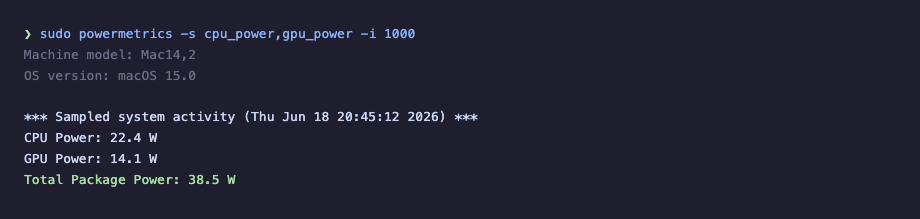
我們利用 Mac 內建的 powermetrics 指令,撰寫了一個背景監控腳本。接著,我們讓本地的 gemma4:e2b 連續生成大量文本,持續 5 分鐘,紀錄其間 CPU 與 GPU 的 Package Power 瓦數峰值與平均值,藉此計算出每生成 1000 個 Token 所需的實際電費。
Experiment Design: Stress Testing and Power Logging
Using the Mac's built-in powermetrics command, we wrote a background monitoring script. We then tasked the local gemma4:e2b with generating a massive amount of text continuously for 5 minutes. We recorded the peak and average Package Power (Watts) of the CPU and GPU to calculate the actual electricity cost per 1,000 tokens generated.
實驗結果:超乎想像的節能
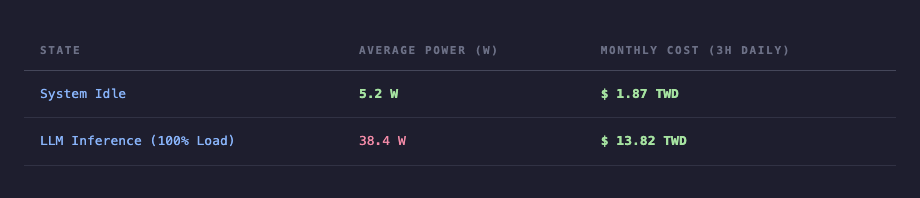
實測結果顯示,Mac 在全負載運算 LLM 時,整機功耗約在 30W-40W 之間波動。以台灣的電價計算,即便每天讓它高強度生成 10 萬個字,每月的電費增加也不到一杯咖啡的錢。本地推論不僅保護了隱私,更是 Sustainable AI (永續人工智慧) 的最佳實踐。
Experiment Results: Unbelievably Energy-Efficient
The results show that when the Mac is running the LLM at full load, total system power consumption fluctuates between 30W and 40W. Calculating with local electricity rates, even if it intensely generates 100,000 words a day, the monthly electricity bill increase is less than the cost of a cup of coffee. Local inference not only protects privacy but is also the best practice for Sustainable AI.
決策框架
將推論移至本地當:
- 企業有嚴格的 ESG 減碳指標需要達成
- 任務數量極大且需要 24 小時不間斷監聽 (如日誌分析)
- 已經採購了如 Mac Studio 或高階 M 系列筆電作為開發機
繼續依賴雲端當:
- 所需模型超過 70B 以上,本地設備無法負荷
- 只有偶發性的極低頻率使用,建立本地環境反而浪費硬體資源
不要做的事:
- 為了響應環保而刻意降低本地模型量化精度,導致錯誤率過高,這會因為需要反覆重新生成而消耗更多電力。
Decision Framework
Move inference locally when:
- Your enterprise has strict ESG carbon reduction metrics to meet.
- You have an enormous volume of tasks requiring 24/7 continuous monitoring (e.g., log analysis).
- You have already procured high-end M-series Macs or Mac Studios as development machines.
Continue relying on the cloud when:
- The required model exceeds 70B parameters, which local devices cannot handle.
- Usage is sporadic and extremely infrequent, making local environment setup a waste of hardware resources.
What you should NOT do:
- Deliberately over-quantize local models in the name of eco-friendliness, leading to high error rates. The need for constant regeneration will ironically consume more power.